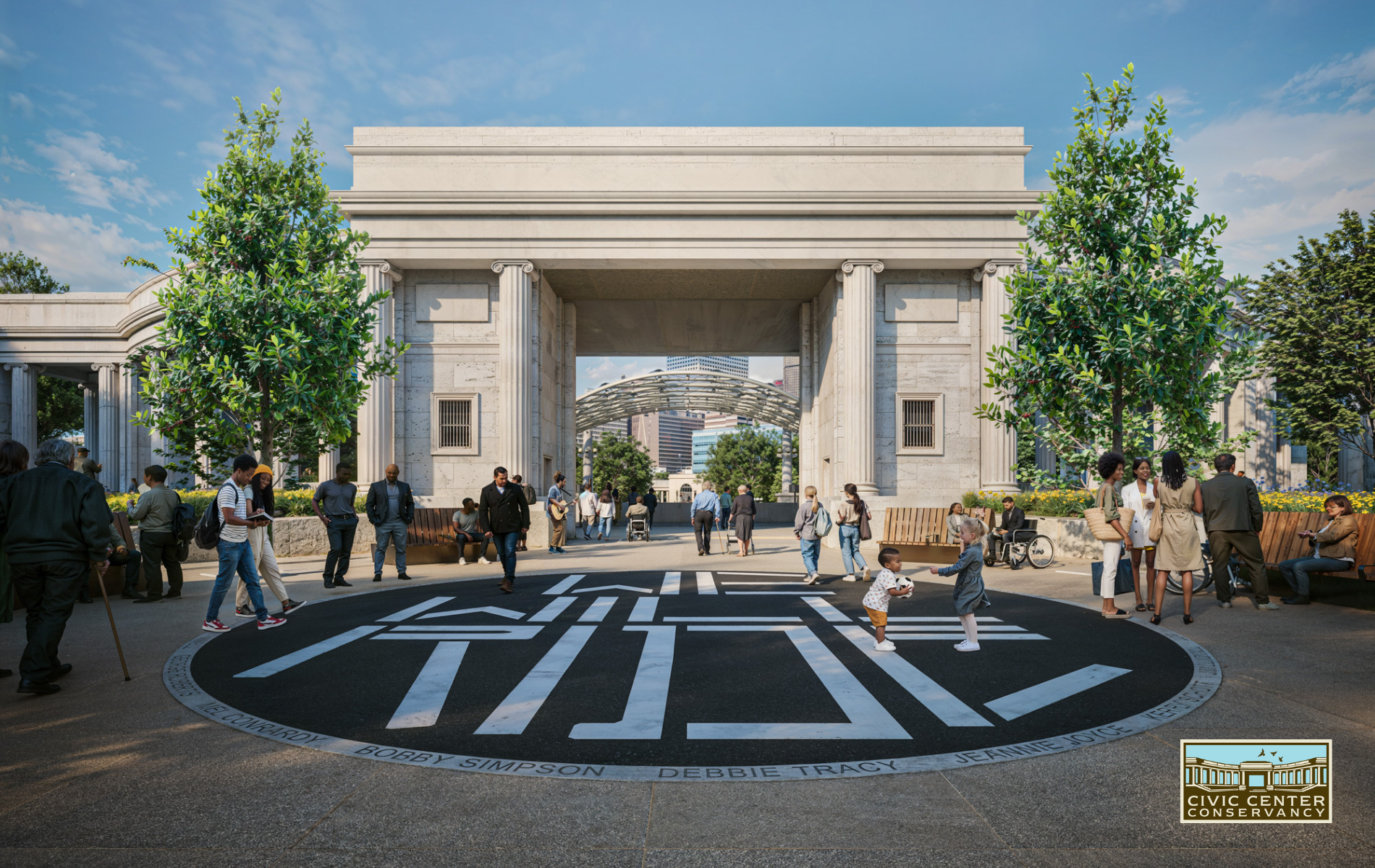
Did you know as part of Civic Center Next 100 project, Denver Parks & Recreation received $1.8 million from the Mellon Foundation to honor the Gang of 19—disability rights activists who famously rode their wheelchairs into the street at the corner of Broadway and Colfax in July 1978 to demand accessible public transportation in Denver. This historic protest eventually catalyzed the passage of federal legislation requiring wheelchair lifts on all new public buses and helped spark the movement that led to the Americans with Disabilities Act of 1990.
Who are the Gang of 19 and why are they being commemorated in Civic Center Park?
The Gang of 19 was a group of activists with disabilities and their non-disabled allies-turned-activists when they sparked the accessible transit movement, right here in Denver. Led by Reverend Wade Blank, on July 5 and 6, 1978, these activists blocked Denver’s RTD buses for 24 hours, chanting “We Will Ride.” The Gang of 19 included Linda Chism-Andre, Renate Rabe-Conrad, Willy Cornelison, Mary Ann Sisneros, Carolyn Finnell, George Roberts, Mel Conrardy, Bobby Simpson, Debbie Tracy, Jeannie Joyce, Kerry Schott, Jim Lundvall, Lori Heezen, Glenn Kopp, Bob Conrad, Larry Ruiz, Cindy Dunn, Paul Brady, and Terri Fowler.
Despite being arguably, the most important single event to occur in the Civic Center district, the Gang of 19 protest remains largely unknown to the broader public.
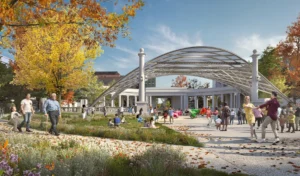
Working closely with Denver’s disability rights community throughout the design process, the project team developed a commemorative design that transforms the south side of the Greek Theatre into a memorial, a new grand entry, and a model of inclusive public space. The centerpiece is a grand new entry featuring circular commemorative paving emblazoned with “WE WILL RIDE”—the Gang of 19’s rallying cry—surrounded by the names of all 19 activists.
The design embodies universal access principles through thoughtful details: seating and plaza spaces with benches accommodating diverse body types and companion seating for wheelchair users, and a sensory garden with plantings that engage all senses and ways of perceiving the space.
This location was strategically chosen as the commemoration because it is the starting point for critical grading work that removes the stairs at the Greek Theater from 14th Avenue. New accessible paths extend throughout Civic Center along the central promenade and outer loop pathways. For the first time in its 100-year history, the reimagined Greek Theater amphitheater, stage, and audience areas are fully accessible—a fitting legacy for those who fought to ensure public spaces belong to everyone.
The Conservancy team learns more about The Gang of 19
In February, the Civic Center Conservancy team joined Curtis Garrett at Atlantis Community Inc. to gain more insight into the Gang of 19’s history and other pivotal movements that established greater independence for people with disabilities.
Of the Gang of 19 protest, Garrett said, “My favorite story is that of Larry Ruiz. Larry had cerebral palsy. He was a wheelchair user and even though Larry could not talk, he had a voice and he chose to use it by chaining himself to a bus. By doing this Larry and the other 18 members of the Gang of 19 showed disabled people across the country they had a voice. Their activism helped push forward implementation of transportation access requirements and created the momentum to the eventual signing of the Americans with Disabilities Act.” One last piece of advice from Larry: If you are going to chain yourself to a bus, chain yourself to the front of the bus.
The tour was both powerful and humbling. We learned so much about how Denver is the hub of activism that spread awareness and action for the Americans with Disabilities Act across the country. Insight into the history of the ADA validates the reimagining of Civic Center Park as a vibrant, inclusive public space for all.
About the Next 100 – Phase 1
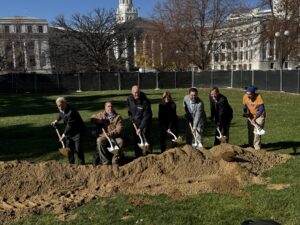
The transformation of Civic Center Park was led by Studio Gang, a world-renowned design firm founded and led by Jeanne Gang. The design team worked closely with Denver Parks and Recreation, Civic Center Conservancy, and the diverse communities of Denver on the design for Civic Center Park. Following the democratic legacy of Civic Center Park, several committees were invited to provide insight into the design, including the Disability Advisory Committee who helped shape the Gang of 19 Commemoration and all of the accessibility elements. We are proud that Civic Center Park’s renovations live up to the crucial call by people living with disabilities: Nothing about us, without us.
When complete, Civic Center Park will be a stage for everyone. The Conservancy is excited for the revitalization of the Park’s Greek Theater area from a historic, but underutilized, monument into a dynamic, visually striking, and performance-ready new outdoor pavilion.
Garrett said the improved accessibility in Civic Center Park will give people with disabilities a chance to celebrate with pride. “We do not want handouts,” Garret said, “if we are provided access and support, we are able to participate in and contribute to our communities.” The revitalizations bring Civic Center Park into the future as a beautiful, sustainable, and accessible public space—a historic park that’s an iconic symbol of “the New West.”
The choice to commemorate Gang of 19 represents Civic Center Park’s dedication to honoring history and expanding accessibility. Garrett said, “More than anything, the commemoration will inspire minds to seek out the history of the Gang of 19 and the impact they had on disabled rights across the country. Disability history is not taught in schools, so people are not aware. Hopefully, people will learn the good, as well as the ugly, parts of disability rights history.”
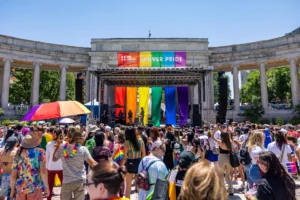
Civic Center is in the heart of downtown Denver, and all are welcome to gather throughout the year. The Park isn’t just a green space – it’s where Denver’s past and future meet, where everyone belongs, and where our community, culture, history, and joy intersect.
Access to public space is something many people rarely have to think about—but for others, it has been the result of decades of advocacy, courage, and persistence. We are proud to honor this legacy of advocacy and activism that helped reshape our city, our nation, and the world beyond, right here in Civic Center Park.
Check back in soon for more updates on the changes underway and what’s to come!